
Horror movies have always attracted outsiders. In part, this is because the genre is frequently about outsiders: the weirdos, freaks, and monsters whose very existence is an intrinsic threat to the self-appointed defenders of the Normal. However, over its century-plus history, horror cinema has usually – though not always – depicted its outsiders in a menacing light, exploiting mainstream culture’s instinct to recoil from anything strange or unconventional. This creates a sticky dilemma for contemporary horror enjoyers, particularly progressive viewers who feel pressured to square their undying devotion to the genre with its at best complicated (and frequently dreadful) treatment of gender, sexuality, race, disability, and neurodivergence.
This tantalizing but frustrating paradox has been one of the central preoccupations of feminist and queer film theory for decades, explored in key texts such as The Madwoman in the Attic (1979), Men, Women, and Chain Saws: Gender in the Modern Horror Film (1992), and Skin Shows: Gothic Horror and the Technology of Monsters (1995). Over time, the natural feedback loop between art and criticism began to nurture a horror cinema that acknowledged the genre’s less savory politics. It can be observed as early as Amy Holden Jones’ The Slumber Party Massacre (1982) – a tongue-in-cheek feminist slasher that arrived while the subgenre’s original golden era was still ongoing – but it has accelerated in the 21st century, resulting in a contemporary horror cinema that is more self-aware and willing to deconstruct the genre’s reactionary tropes rather than uncritically embrace them.
Occasionally, this leads to baffling misfires like the second Black Christmas remake (2019), which used the reflected glow of Bob Clark’s pioneering and sneakily feminist 1974 slasher to shore up the new film’s forgettable and morally confused girl-power aspirations. Yet even the nerviest and most bloody-minded exemplars of “woke horror” – e.g., the cannibal horror freakout Raw (2016), the rape-revenge gorefest Revenge (2017), or the queer giallo pastiche Knife+Heart (2018) – tend to be corrective rather retrospective. Understandably so: It is likely easier and more appealing for an up-and-coming filmmaker to craft a new vision that rewrites genre conventions than it is to explicitly engage with the possibly unsolvable puzzle of the problematic past.
The most immediately striking aspect of writer-director Jane Schoenbrun’s gloriously bizarre and ill-behaved third feature, Teenage Sex and Death at Camp Miasma, is its willingness (its hot-and-bothered eagerness, even) to dig its fingers three knuckles deep into that gooey puzzle. Schoenbrun tackles their own affection for the unwokest of violent delights – specifically the slasher subgenre and its thorny relationship with queer desire – with both intellectual rigor and a shuddering, multi-climax exhale of bliss. Here is a work that is as enthusiastically geeky about the cinematic past as a freshly minted film-studies graduate, and as quiveringly horny as a home-schooled teenage lesbian discovering her first volume of Bloom Into You.
Camp Miasma evinces the same poetic, hyper-colored cinematic intuition that made Schoenbrun’s prior features (We’re All Going to the World’s Fair, I Saw the TV Glow) such indelible experiences, but here the director’s discomfiting surrealism is cut with an unexpected thematic forthrightness. Echoing both Brian De Palma’s fascination with watching (and being watched) and Catherine Breillat’s absorption with the sticky contradictions of lust, Schoenbrun advances two of the most affirming, anti-repressive cinematic theses of the decade. Firstly, that sexual fantasy is the last truly safe space in a world where omni-directional judgment seems ascendant. And second, that the lowest, most problematic art can serve as a secret passage to the unearthly delights we’ve forbidden even to our hidden selves.
Camp Miasma’s sharply drawn and faintly autobiographical protagonist is crucial to the film’s success. Kris Williams (Hacks breakout Hannah Einbinder) is an eager but paralyzingly self-conscious young director who made her arthouse name with a film “from the perspective of the shower curtain in Psycho” (whatever that means). This early critical success has landed Kris a plum assignment: reviving the schlocky, decades-old slasher franchise Camp Miasma. This is no mere work-for-hire gig, as Kris has long been obsessed with Miasma; a clandestine late-night VHS viewing of the first film left a deep impression on her developing, 8-year-old brain. Never mind that the series devolved into an endless string of terrible, diminishing-returns sequels. (The fourth one is better than you’d think, Kris insists.) And never mind that from its inception, the franchise trafficked in the kind of misogyny, homophobia, and transphobia that she normally abhors. The filmmaker has already thought long and hard (one might say overthought) how to thread the reboot/requel needle and bring Camp Miasma into a new, more enlightened era.
Kris believes she needs just one secret ingredient: Billy Presley (Gillian Anderson), the actress who portrayed the original film’s final girl but never returned for any of the sequels. To secure Billy’s involvement, Kris travels to a wintery patch of nowhere in the Pacific Northwest, where the retired performer now lives as a Salinger-level recluse at Camp Tivoli, the same abandoned summer camp once used as a Camp Miasma filming location. Unable to escape the shadow of her niche claim to fame, Billy swans about in her caftans and turbans, a scream-queen Norma Desmond living in a perfectly preserved museum to her erstwhile stardom (and foundational trauma). Kris, being a compulsive cinephile, privately makes the Sunset Boulevard comparison to her partner, but in a moment of self-doubting anxiety, she later pretends not to know the character’s name in front of Billy. (Revealing one’s weirdo hyper-fixations might freak out the talent and queer the deal, after all.)
Kris needn’t have worried, as it turns out. As she wanders the dreamy, out-of-time environs of the snowbound campground, she quickly ascertains that Billy shares her fascination with Camp Miasma. However, nearly 40 years of eremitic self-reflection have bestowed the former actress with a witchy aura of secret wisdom – not to mention a glamorous, fine-wine sex appeal. Billy is welcoming but inscrutable, her honey-dipped Dolly Parton drawl alternately flattering and challenging Kris. “Tell me about yourself,” Billy commands over a dinner of fast-food fried chicken, but when Kris responds with a sketch of her professional achievements and ambitions, the older woman cuts her off: “No, tell me who you are.” Aye, there’s the rub. Beyond biographical factoids – lesbian, near-sighted, ambivalently polyamorous – Kris concedes that she doesn’t have an identity outside of her work and cinematic obsessions. (She even seems to subsist primarily on movie-theater junk food: popcorn, chocolate, and a heroic quantity of gummi candy.)
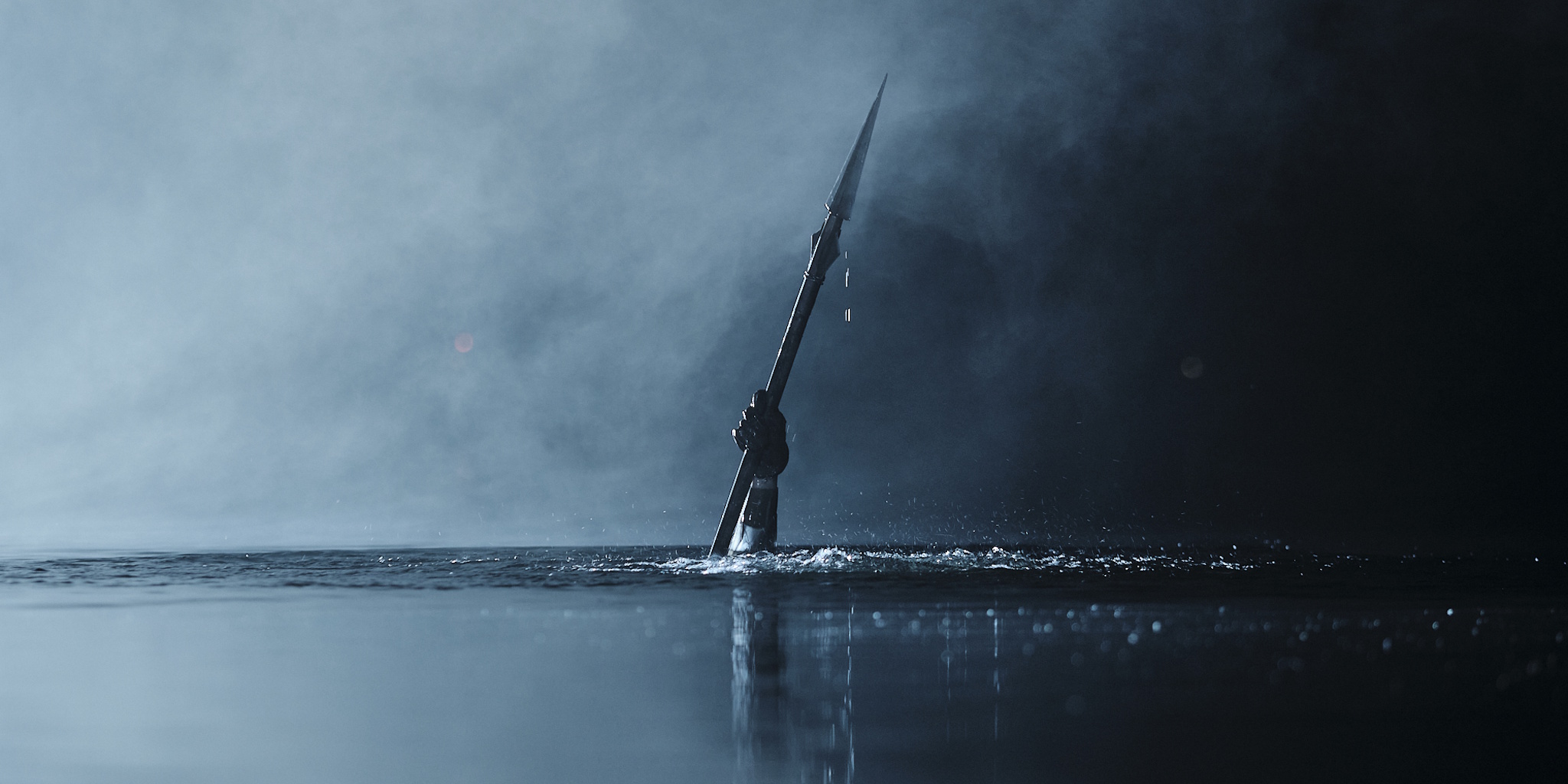
At one point, the pair watch Billy’s personal print of the original Camp Miasma, which allows Schoenbrun to present a sampling of the scuzzy, gruesome pleasures of the film-within-the-film. Camp Miasma’s killer, “Little Death” (Jack Haven), is a Jason Voorhees-like revenant, although their origin story is modeled on Angela Baker from Sleepaway Camp (1983). Forced to live as both a boy and a girl by their deranged parents, Little Death was drowned by their fellow campers in Camp Miasma’s lake. Outfitted in a body-bag-like pair of coveralls and wearing a boxy, industrial air diffuser as a makeshift mask, they rise repeatedly from the lake’s murky water, slaughtering campers, counselors, and other luckless interlopers with a strange, barbed spear. The climax of the film, in which Billy’s character painfully loses her virginity to a heedless, fumbling boy while Little Death closes in on them, crescendos with an image that has captivated Kris for decades: a reflection of Little Death, their blood-drenched spear poised to strike, seen in an extreme close-up of young Billy’s eye.
This being a Schoenbrun feature, things start to get weird the longer that Kris spends at Camp Tivoli. What starts as an ostensible business dinner becomes a multi-day psychosexual tango in which Billy not-so-subtly attempts to coax Kris out of her self-effacing, sexually repressed shell. Not that Kris isn’t into it – Billy is gorgeous and magnetic, regal as an empress and yet folksy as your favorite aunt – but something much stranger is happening than a mere May-December sapphic fling. The boundaries between reality and fantasy, fact and fiction begin to dissolve like so much melting acetate. Billy speaks about her climactic scene as if the events actually occurred, a filmed sexual assault that culminated in an orgasmic, voyeuristic death-vision in which she was both victim and murderer. (The killer’s moniker is perhaps a bit on the nose.) The concentric squares of Little Death’s diffuser mask appear everywhere: in the countless drawings and paintings that Billy creates in a hypnotic frenzy, but also in the apparition that Kris sees in her waking nightmares. During a disastrous web conference with her producers, the filmmaker descends into an alarmingly manic state, declaring with the wild-eyed zeal of a doomed Lovecraftian character, “There is a hole at the bottom of the lake where the movies come from!”
Schoenbrun’s oneiric, delightfully unpredictable storytelling muddles time and space, such that viewers are eventually unsure if anything they are seeing is truly real. (John Carpenter’s In Mouth of Madness seems like a probable touchstone, alongside other horror landmarks such as Body Double and Videodrome.) The filmmaker conjures a phantasmagorical movie-reality where the artifice is the point: deliberately phony-looking matte paintings glowing in pastel hues; a monster lair whose walls writhe and glisten like a living organism; and anime-worthy fountains of pressurized bodily fluids. Yet the vexing voodoo of Camp Miasma is as much about the small, destabilizing details as the film’s grandest of Grand Guignol gestures. Comedian Kevin McDonald briefly appears as a local innkeeper who was once cast in one of the latter, ill-regarded sequels – but wait, isn’t that him in the original film as well? And why is the first Camp Miasma’s setting an ambiguous mishmash of conflicting production-design minutiae variously indicating the 1970s, ’80s, and ’90s? What year is this?
The film’s slippery vibe and violent tonal shifts wouldn’t work as successfully as they do without Einbinder, whose charmingly nerdly, unexpectedly vulnerable performance carries Schoenbrun’s script. In a different kind of metatextual horror film, a protagonist’s self-aware deployment of phrases like “zombie IP” and “female gaze” would come off as ruinously declaratory, but Einbinder wholly convinces as a woman bubbling over with artistic-intellectual passion, even as that exuberance masks a deep self-loathing. She has a terrific, smoldering chemistry with Anderson, but as beguilingly mysterious as Billy might be, Kris is the heart of the film. Her insecurity about her true desires and their bone-deep, almost paraphilic entanglement with a slice of misogynistic pop-culture flotsam is the conflict at the heart of the film, a conflict that Billy (and Little Death) are eager to help her resolve. More than a love letter to slasher-movie trash, Camp Miasma is a plea to unapologetically embrace what excites us, aesthetically and erotically. It urges us to stop making ourselves small and be whatever we want to be in our most intimate moments: whether a quavering victim, an unstoppable killer, or both at the same time.
Teenage Sex and Death at Camp Miasma is now playing select theaters.