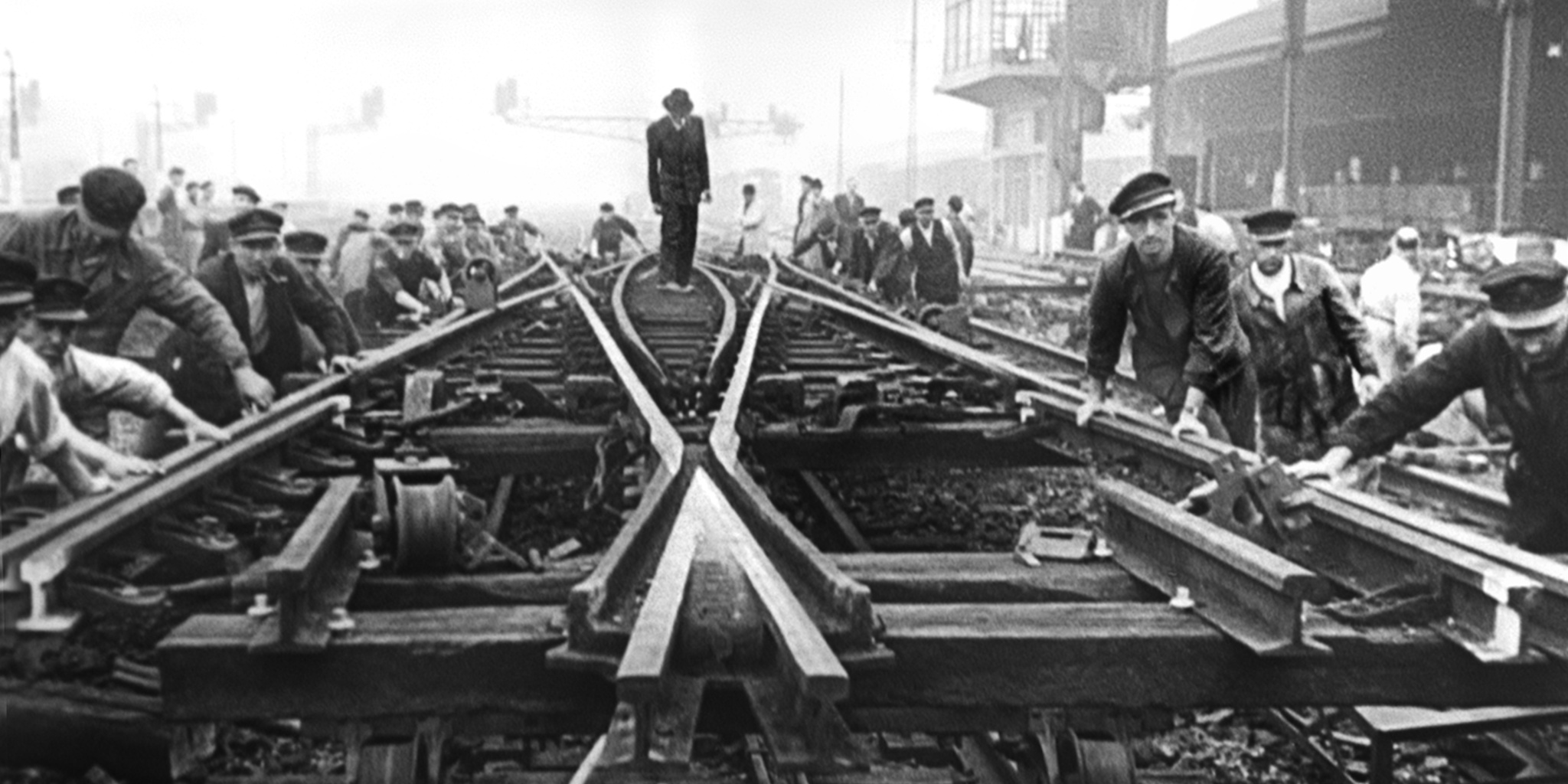

A wordless – though scarcely silent – rail journey through the first half of the 20th century, the remarkable archival documentary Trains posits that the locomotive served as not just a revolutionary mode of transport but also a driving engine of history. Drawing on footage from 46 archives, the film proceeds in roughly chronological order, devoting particular attention to the two world wars – in which trains played a crucial and highly problematic role – but also chronicling the everyday railroading experiences of the traveling European public.
Beginning with a fascinating sequence that shows several key steps in the assembly of a locomotive, the film eventually moves from the factory floor to train yards, grand stations, and bustling platforms filled with passengers. Having efficiently established train travel’s essential elements, director Maciej J. Drygas then subtly shifts into the film’s next major sequence – on World War I – by showing soldiers and sailors lounging contentedly in a rail cafe. That cheery leisure ends, however, when commanding officers greet formally dressed politicians and fellow generals as they descend from a train car: War is about to commence.
Densely packed trains become the means of conveying troops en masse to the battlefields, with vast stores of munitions moving as freight and the railways transformed into weapons by placing massive cannons on tracks. Soon, with grim inevitability, legions of soldiers – now horrifyingly maimed, disfigured, or palsied – make return trips aboard the same trains that bore them to the front. The railroads also reflect the societal changes created by the conflict: Women grease the wheels, wash the cars, and maintain the tracks, filling the roles of the millions of men sacrificed on the killing fields.
During the interregnum between the wars, Trains spotlights the surprising amenities that railroads added to entertain and coddle travelers: barbering, elaborate meals, fashion shows, even dancing. In Drygas’ most thoughtfully constructed sequence, he uses one of these enhancements – a train-car film auditorium – to transition to World War II. After a cameo of director and montage theoretician Sergei Eisenstein (who is never identified) exchanging some playful words with a traveling companion in a train car, Drygas provides establishing shots of the rail-based theater and briefly shows one of its offerings: a self-reflexive short of a train hurtling toward the viewers – a true moving picture! Drygas and editor Rafał Listopad then cut to a scene from Charlie Chaplin’s “The Idle Class” (the only narrative footage seen in the doc), in which the Tramp climbs from a storage box underneath a train car after it pulls into a glitzy resort.
Trains follows up with shots of the real-life Chaplin, white haired and dapper, as he arrives by train and is met by throngs of adoring fans, who hoist him on their shoulders and carry him from the station. As his car wends through the streets, Chaplin stands, smiles broadly, and waves to his admirers, who overflow the sidewalks and wildly cheer. Those scenes of excited idolatry are then replicated in subsequent shots that feature similarly outsize crowds extending arms in greeting as yet another train glides into a station: Instead of waves, however, these are Nazi salutes, and it’s Adolph Hitler who’s swarmed by his passionate devotees. Chaplin, of course, made use of his resemblance to Hitler in The Great Dictator, which Trains thus indirectly and cleverly references.
Trains’ extended section on World War II inevitably reprises some aspects of the earlier conflict it chronicles – acknowledging war’s sadly repetitive nature – but the Nazis’ use of trains as one of their instruments of genocide adds a new layer of complexity. Drygas and his research team also unearth striking images of the displaced as they clamber aboard and overfill trains immediately postwar: spilling from freight cars and precariously clinging to the sides or riding on top when no room remains inside.
As Trains steams to its conclusion, it becomes increasingly melancholic – the cumulative weight of the wars bearing down on the exhausted passengers, who doze fitfully in seats, bed down for uncomfortable slumber on hard benches in stations, or stare in slack-jawed, dazed bewilderment at schedule boards – and the film’s final footage turns abstract: landscapes dimly glimpsed through a window glazed with ice, hair blowing in alternating light and shadow, tracks endlessly crisscrossing.
Haunting and eerily beautiful, Trains’ lustrous black-and-white images induce a trance-like state in the viewer, an effect enhanced by Saulius Urbanavicius’ extraordinary sound design, a Lynchian industrial symphony of metallic squeals and clacks, drones and jump-scare whistle blasts, with excerpts from Paweł Szymański’s composition “Compartment 2, Car 7” occasionally embedded into the dense mix. Climb aboard and take a transporting Trains trip.
Trains screens nightly at 7:30 p.m. on Jul 24 – 26 at the Webster University Film Series.