
The original trilogy of Evil Dead films directed by Sam Raimi vary significantly in tone: The Evil Dead (1981) is an assaultive shriek of midnight-movie nastiness, Evil Dead II (1987) remixes the first feature as a pitch-perfect slapstick horror-comedy, and Army of Darkness (1992) mutates the series’ premise yet again into a dark medieval fantasy (via some time-travel shenanigans). The two elements that tie together Raimi’s protean trilogy are 1) the fabled grimoire the Necronomicon and 2) the vile Deadites, the gleefully sadistic demonic entities summoned from Hell by the evil tome’s incantations. Throw in some over-the-top gore and a Chekhov’s power tool or two, and you have yourself an Evil Dead film. The formula is simple but reliable, persisting through a 30-years-later sequel television series created by Raimi (Ash vs Evil Dead) as well as legacy features helmed by other, up-and-coming horror filmmakers. Fede Álvarez’s gruesome but largely pointless Evil Dead (2013) is essentially a soft re-do of the 1981 original, while Lee Cronin’s delightfully deranged Evil Dead Rise (2023) adds a setting change and a sicko mommy-horror twist.
However, all the entries in the Evil Dead franchise share something critical beyond chainsaws and buckets of blood: the fundamental unfairness of the dark, amoral reality that Raimi originally envisioned. Simply put, the world of Evil Dead is a cruel one. Although the franchise borrows some aesthetic and conceptual elements from the Gothic tradition, Raimi’s series does not unfold in a universe that owes much to Christianity (or any other religion), theologically speaking. Sins are not punished proportionally and villains do not receive their comeuppance. There’s no cosmic justice in a world where characters can be possessed, slaughtered, and damned for the crime of simply reading from a book. (In this, the series shares some DNA with Raimi’s otherwise unrelated horror-comedy Drag Me to Hell.) Anyone can die in Evil Dead for almost any reason: horny college students, of course, but also parents, children, the elderly, pets, good people, bad people, and random bystanders. Blamelessness does not protect one from the devouring maw of Hell, which is less of a moral force in Raimi’s imagination than an elemental one, a stand-in for the absurd perversions of death itself.
French director Sébastien Vaniček’s Evil Dead Burn – a standalone story that nonetheless also functions as a direct sequel to Rise – continues this tradition. It’s a bleak, hostile film, unleavened by the screwball/splattershtick humor that characterizes much of Raimi’s work in the franchise. However, that viciousness is neither unprecedented (see the ’81 and ’13 features) nor tonally out-of-place in a series that is robust enough to contain multitudes, despite its straightforward premise. Where Rise transformed the regrets and resentments of motherhood into the stuff of emotionally transgressive horror, Burn catalyzes the tenacious evils of hidden emotional and physical abuse, allowing them to spill out into the open in hideously spectacular fashion.
A skeptic might assert that the last thing an Evil Dead feature should be is yet another art-horror film about generational trauma. And they wouldn’t be entirely wrong about that, even if the text of the franchise itself contradicts the implication that deeper themes and characterization are out of bounds in Evil Dead. (Ash Williams’ arc in the otherwise fun-centric Ash vs Evil Dead is foremost about his Deadite-related PTSD, after all.) Never fear: Evil Dead Burn is uncut New Extremity-adjacent horror with a gooey slathering of action-flick momentum. It may not handle thorny subjects like intimate partner violence with a subtle touch, but subtlety has never been a part of this series’ satanic warp and weft. How could it be, when its most indelible motif is a loved one who abruptly transforms into an obscenity-spewing, bloodthirsty demon?
Evil Dead Burn – co-written by Vaniček and Florent Bernard – focuses on aspiring photographer Alice Price (Climax’s Souheila Yacoub), the French wife of alpha-male American restaurant and club owner Will (Goerge Pullar). Their marriage is not-so-secretly on the rocks, and their mutual grievances and bitterness come pouring out uncomfortably during an ad hoc birthday celebration for Will’s nice-guy little brother, Joseph (Hunter Doohan), a struggling writer. Will ultimately drives off in a huff, only to run literally headlong into a familiar-looking and unusually mission-focused Deadite who is wandering down a twisting rural road. This encounter sends Will’s car hurtling into the woods and concludes in his horrific, fatal immolation while he is still belted into the overturned vehicle.
Shell-shocked and uncertain of her feelings in the wake of this tragedy, Alice is obliged to play the part of the devastated widow with her husband’s family. Joseph and his girlfriend, Thya (Luciane Buchanan), are pleasant enough, but Will’s parents, Susan (Tandi Wright) and Edgar (Erroll Shand), are another matter. Their chilly resentment is only amplified after their oldest child’s death, and Alice is in the unwinnable position of being reviled as a son-stealing interloper while also being judged for not integrating more completely into the family. Occupied with caring for her disabled and dementia-addled mother, Polly (Maude Davey), Susan is a textbook passive-aggressive mother-in-law, offhandedly hypercritical and fixated on her own martyrdom. Edgar, meanwhile, is taciturn, short-tempered, and masculinity obsessed. (It’s clear who their favored son was, to Joseph’s quiet consternation.)
After Will’s cremation and funeral service – incongruously soundtracked by the din of the mortuary’s ongoing construction – the Prices regroup at a nearby family-owned farmhouse where Joseph has been living and conducting research for an upcoming book. Besides centering their screenplay on a grieving family rather than a gaggle of twenty-somethings on a weekend getaway, Vaniček and Bernard add another modest conceptual twist to the Evil Dead template. Instead of the Necronomicon itself, Burn’s MacGuffin of choice is an ancient, Deadite-slaying Sumerian dagger that Susan’s eccentric, globe-trotting father secreted away from the forces of Hell. (This might feel like a lore retcon to suit contemporary genre sensibilities, but in fact it has been an often-overlooked element of the Evil Dead mythos since the franchise’s inception.)
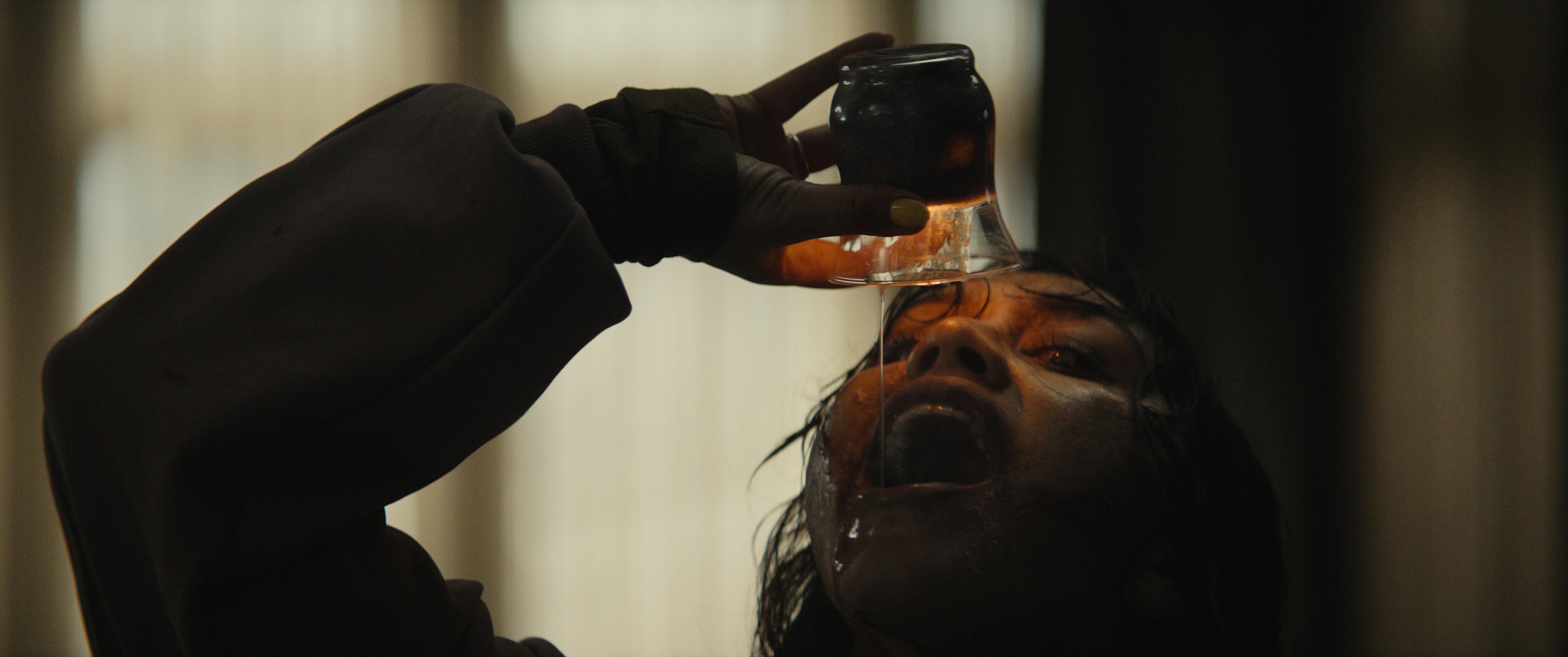
The specifics of the plot don’t really matter much: Suffice to say that the Deadites are drawn to the dagger and lay siege to the house to recover it, quickly possessing, mutilating, and slaughtering the family members (not necessarily in that order). Alice, as the designated Final Girl, is obliged to work out her lingering issues with Will and his dysfunctional clan in real time while trying to survive this unholy (and very bloody) assault. As in prior entries, the Deadites’ powers and the mechanics of demonic possession are intentionally left somewhat fuzzy. The minions of Hell are governed less by esoteric occult principles than the Rule of Cool, and they take great delight in tormenting their victims psychologically as well as physically, as though the emotional trauma of their vulgar mind games was itself a source of infernal sustenance.
Director Vaniček (Infested) approaches the series’ trademark, gratuitous violence with an action filmmaker’s eye, seemingly drawing inspiration from the works of directors such as Gareth Evans, Tsui Hark, and Timo Tjahjanto. Burn stages its demonic chaos like a close-quarters, bone-crunching rumble, where every fragment of the environment has the potential to act as an improvised weapon – and not just Edgar’s gas-powered brush cutter, either. (There’s some horrifying ear trauma involving a fountain pen that had this critic wincing.) As expressed by cinematographer Philip Lozano and editor Maxine Caro, the carnage has a percussive, rhythmic quality that recalls Edgar Wright’s more action-oriented features. Whereas Wright leans into the lively musicality of his moving images (no matter how textually horrific), Vaniček uses his directorial toolkit to create a sensation of relentless, grinding doom. Deploying whip-pans, dizzying tilts, and shallow focus with giddy abandon, his overcranked cinematic language is exhausting (by design) yet purposeful. Excepting the cheese-grater incident in Rise, the violence of Evil Dead has rarely felt so uncomfortably visceral, in a way that evokes phantom pains in the viewer.
The film’s relatively slight engagement with themes of family trauma, violent cycles, and inherited pathologies is somewhat less assured. (Hereditary this is not.) Each viewer’s mileage may vary as to whether centering Alice’s history of abuse at her husband’s hands is ultimately an astute or exploitative gesture. Luckily, the screenplay gives Yacoub the space to discover Alice’s fed-up decisiveness without diminishing her scars or engaging in victim-blaming. In one fantastic sequence, Alice survives a chaotic Deadite attack simply by running and cowering, which plays like a riposte to the notion that every Final Girl must also be a badass superheroine right out of the gate. Of course, like all Evil Dead protagonists, Alice must eventually confront the forces of Hell directly, with a roaring, heavy-duty power tool in hand. The key dimension of her catharsis, however, is less about turning violence back on her tormentors than standing firm in her conviction that good intentions are not enough. Especially in a world as cruel as Evil Dead’s.
Evil Dead Burn is now playing in theaters everywhere.