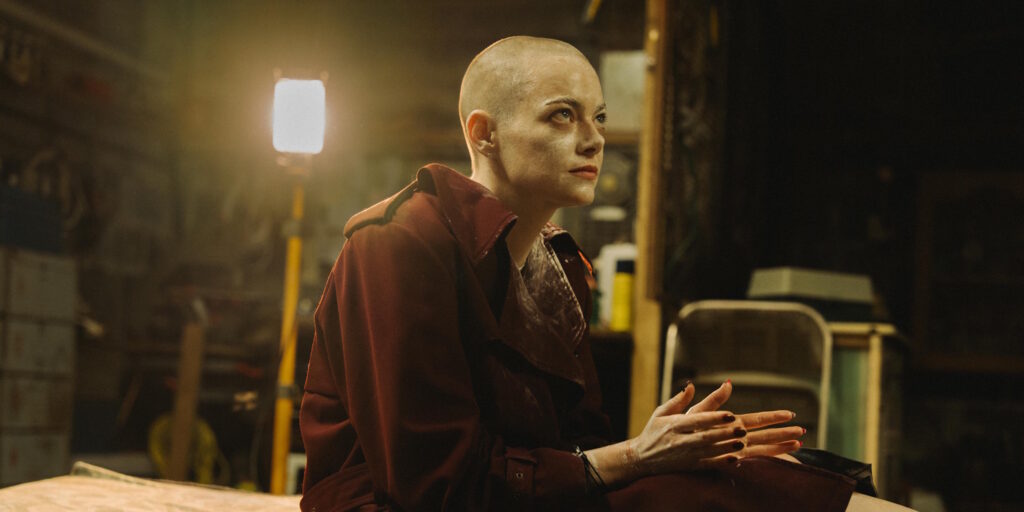

Filmmaker Julia Loktev follows My Undesirable Friends: Part I – Last Air in Moscow, her sprawling, 324-minute chronicle of Russia’s methodical elimination of the free press, with Part II – Exile, an even more ambitious (and yet longer) documentary that tracks her subjects as they disperse across the globe.
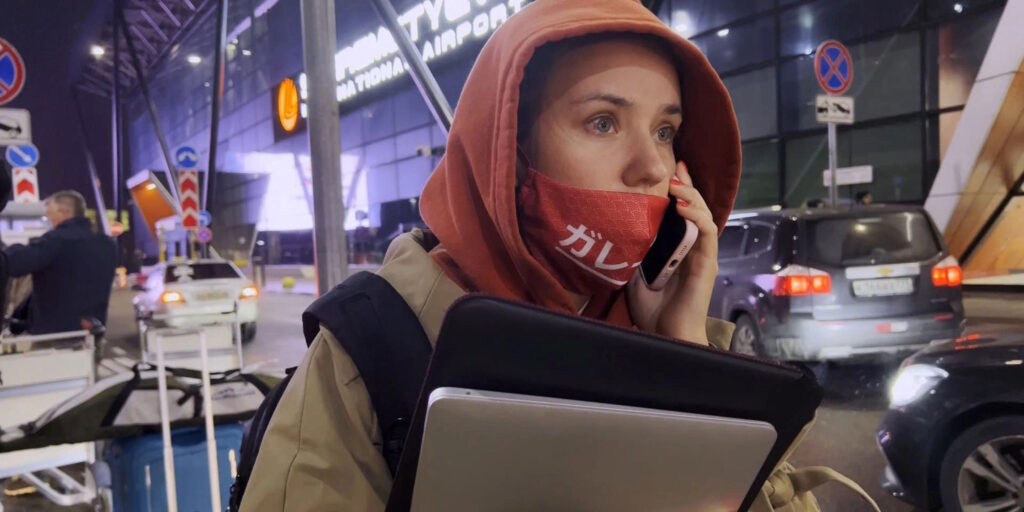
My Undesirable Friends’ first part set out to profile Russian journalists declared “foreign agents” by the government and to record the impact of the law’s Kafka-esque requirements on their lives. Those plans were upended, however, when Russia invaded Ukraine in February 2022, with the Kremlin swiftly ramping up its already draconian media censorship by banning the few remaining outposts of information not sanctioned by the state. Although the journalists featured in Part I initially attempted to continue their independent reporting, that option was foreclosed within a week of the war’s outset. Faced with certain arrest and imprisonment, Lotkev’s subjects all opted to flee their country, which is the inflection point at which Part II begins.
(For more background, see my review of Part I. An important note: Although having seen the first part of My Undesirable Friends will considerably enhance your experience of Part II, it’s not essential. Through explanatory titles, Lotkev provides enough context to allow a new viewer to become sufficiently familiar with her subjects’ biographical essentials. That said, if you have the time, certainly seek out Part I before watching its sequel. Access to Part I requires a subscription to MUBI – the film streams exclusively on that platform at present – but the frugal can take advantage of a free weeklong trial.)
As in Last Air in Moscow, Loktev smartly divides the film into five chapters, which makes its overall length slightly less intimidating and allows for end-of-segment updates on the principals’ lives at that temporal juncture. The latter information proves especially helpful in keeping the viewer grounded because Exile covers significantly more time than its predecessor, extending from 2022 to 2026, and most of its subjects move with dizzying frequency, compelled to relocate because of job opportunities (which are almost always of a temporary nature), visa limits, or host countries’ ever-changeable alliances and political calculations.
In Exile, Lotkev further ups the ante of Last Air in Moscow by not only staying in regular touch with her original subjects but also introducing several new principals. Anna Nezmer remains vitally important: Again credited as co-director, she was Lotkev’s Virgil in Part I, connecting the filmmaker with her media colleagues and serving as a guide through the journalistic hell over which Vladimir Putin imperiously presides. With the film’s original cast of reporters, podcasters, and show hosts now scattered around the world, Nezmer fulfills a different function here. Married with a family – the other subjects are younger, single, or childless – Nezmer perhaps most acutely reflects the stresses of exile because of her daughter’s anguish over the recurrent upheavals in her young life.
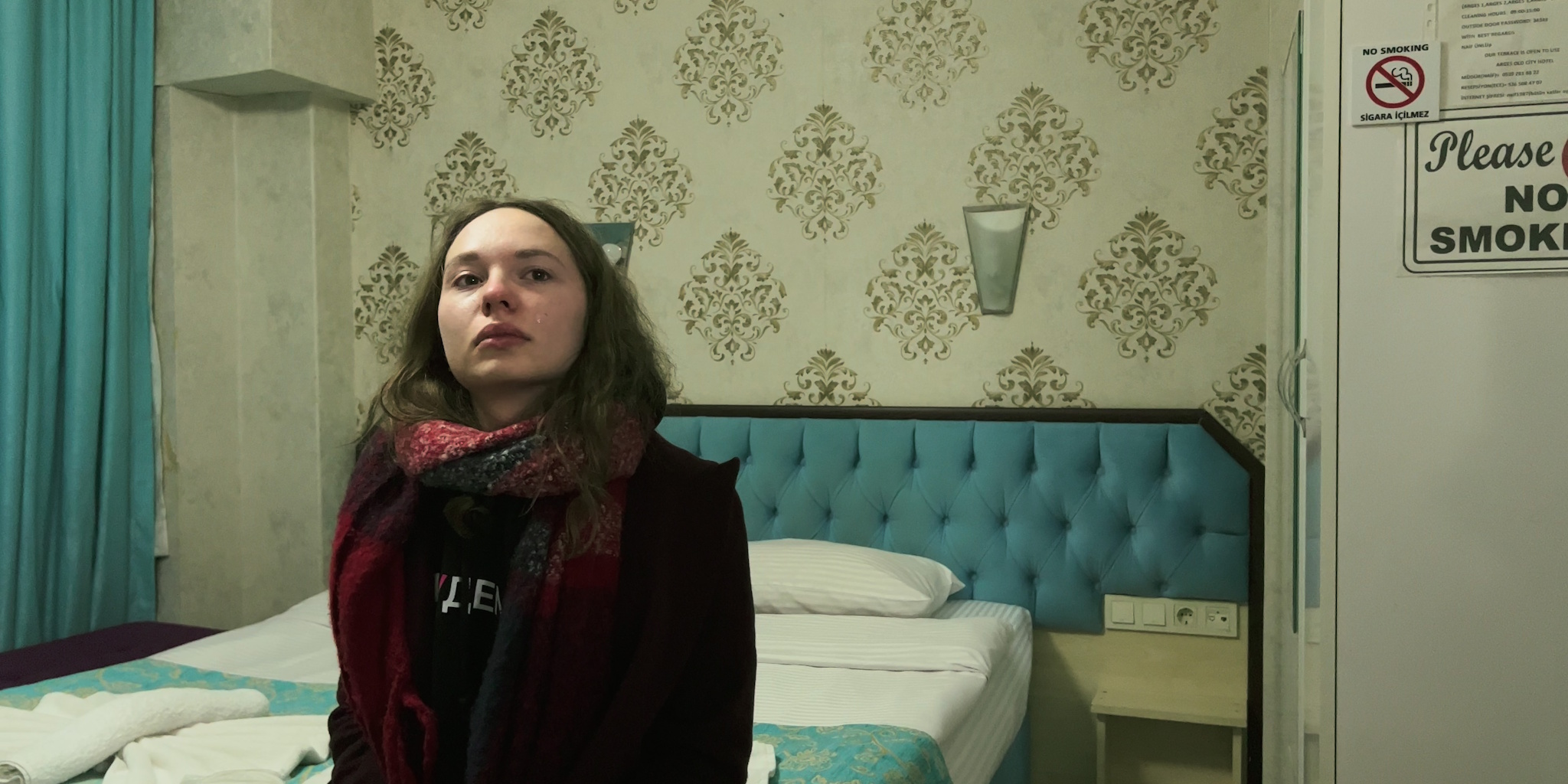
Exile profoundly affects all of the journalists, of course, and one of the film’s new subjects – Valeria Ratnikova – especially suffers from frequent bouts of wrenching despair. As a 22-year-old anchor on TV Rain – the independent online station that figured prominently in Part I – Ratnikova briefly appeared in Last Air in Moscow as the host of a smiling-through-the-tears New Year’s special, but she assumes a much more prominent role in Exile. Having left everything behind in Russia, including a boyfriend, Ratnikova is often emotionally distraught, but – like all of Exile’s principals – she exhibits heartbreaking self-awareness and empathy, always careful to distinguish her own personal troubles from the far greater suffering of the Ukrainian people. She also thoughtfully articulates doubts about TV Rain’s impact on its Russian audience: What effect, ultimately, does access to uncensored information have if the population lacks any political autonomy? Can the truth, in this case, set anyone free?
A related question frequently nettles the films’ other protagonists: Given the steady diet of state propaganda they’re force-fed, can Russian viewers any longer even recognize the truth? In phone conversations, the parents of Exile’s subjects again and again appear mystified by their children’s decision to leave the country, and they parrot Kremlin talking points about the “special military action” in Ukraine, casually dismissing Western reports of war crimes as disproved by state media. As one of the exasperated journalists pointedly observes, the Russian people have exchanged their liberty for the relative comfort that Putin’s authoritarian regime has provided.
Like Ratnikova, two other Exile additions – the cross-border married couple of Nataliya Gumenyuk, a Ukrainian, and Peter Ruzavin, a Russian – also enhance the film, in this case by providing privileged insight into the war from Kyiv. For naïve Americans, Ukraine might actually seem the logical place for the dispersing journalists to relocate – much of their reporting, after all, focuses on the war – but they’re unwelcome and regarded with intense suspicion because Ukrainians understandably place no trust in Russians, even those purporting to support their country. (The film confirms the necessity of such wariness when a Russian double agent, a supposed human-rights activist, temporarily gulls Important Stories writer Alesya Marokhovskaya into trusting her good intentions.)
Ukrainians’ skepticism seriously complicates the exiled journalists’ ability to report and secure interviews, and that already difficult situation worsens exponentially for TV Rain when one of its hosts appears to express on-air support for Russian soldiers. The station immediately fires the anchor but still faces an existential crisis: Ukrainians react with undiluted anger, and Latvia, which had provided a haven for TV Rain after its Russian shutdown, cravenly reacts to the controversy by finding an excuse to revoke its broadcast license. The station survives the cataclysm by shifting its operations to Amsterdam, but the section of Exile chronicling the incident’s immediate aftermath is among its most riveting.
Because the film’s other subjects have such difficulty in directly accessing Ukraine, Gumenyuk and Ruzavin’s presence in Exile proves invaluable, allowing Loktev to provide a revelatory view from within the country. Gumenyuk – whose compelling English-language reporting can be found in such outlets as the Atlantic, New York Times, and Guardian (and whose book The Drone Revolution: How Ukrainians Changed the Way Wars Are Fought is scheduled for U.S. publication in February 2027) – is an especially engaging figure. Sharp, funny, and resolutely tough minded, she remains almost unfathomably cheerful in the face of adversity. A longtime TV Rain reporter, Ruzavin feels compelled to leave the station after the protests that follow the fired host’s incendiary remarks. He first collaborates with Gumenyuk, but Ruzavin eventually decides that journalism is an insufficient contribution to his adopted country and instead joins the military. His subsequent experience as a Russian soldier fighting for Ukraine lends the film yet another unique perspective on the war.
The film’s new voices by no means displace Lotkev’s original cohort of journalistic subjects, and she doggedly trails them across the globe, jetting from (among other destinations) Turkey, Israel, Georgia, Latvia, and Ukraine to the Czech Republic, the Netherlands, and the United States. She even briefly returns to Russia when Ksenia Mironova, another TV Rain reporter, risks a visit to witness the sentencing of her fiancé, journalist Ivan Safronov, to 22 years in a Siberian prison for demonstrably false charges of treason.
The 2024 death of dissident politician Alexei Navalny in an equally remote Russian prison serves as another of Exile’s most devastating sequences. As TV Rain works to confirm the grim news, Navalny’s murder makes the continuing dangers to the film’s own subjects all too terrifyingly clear. In fact, during Exile’s course, Novaya Gazeta long-form journalist Elena Kostyuchenko – author of the essential book I Love Russia: Reporting from a Lost Country – is “mysteriously” sickened in a manner similar to Navalny’s poisoning in 2020. Nor are such direct attacks the only means that Russia employs to harass and punish the film’s journalists: Ratnikova, for example, is tried and convicted in absentia and sentenced to seven years of imprisonment for disseminating “fake news” about Russian war crimes.
With Russia’s full-scale war against Ukraine now in its fifth year, the subjects of My Undesirable Friends have sadly resigned themselves to a long and perhaps permanent exile. But, inspiringly, they persist in their relentless opposition to Russia’s human-rights abuses both at home and in Ukraine. Given the recent actions of Putin enabler Donald Trump, our very own would-be autocrat, U.S. viewers would do well to pay rapt attention to the hard lessons taught by My Undesirable Friends: Part II – Exile.
The Webster University Film Series will be screening My Undesirable Friends: Part II – Exile in two segments over the Oct. 16 – 18 weekend. Chapters 1 – 3 will screen on Friday, Oct. 16 at 6:30 p.m. Chapters 4 – 5 will screen on Saturday, Oct. 17 at 7 p.m. Both segments will then be screened again, this time back-to-back, on Sunday, Oct. 18 at 3:15 p.m. and 7 p.m., respectively.