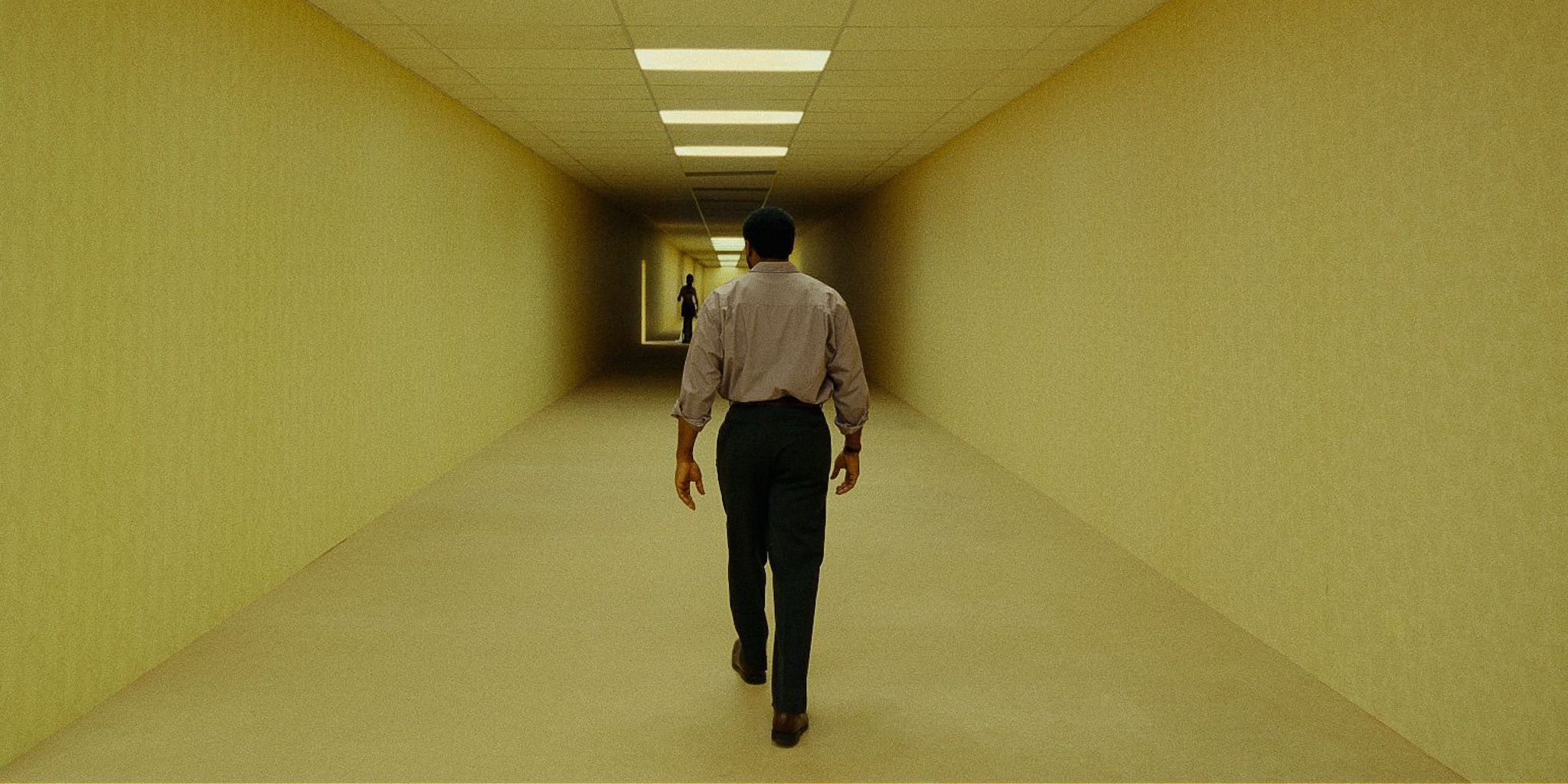

The Backrooms invites interlopers to explore its endless passageways. In the years since an iconic photo of an under-renovation hobby store showed up in a 4chan thread, it has set the minds of internet users aflame. Various theories, stories, videos, games, and memes have been made about the creepypasta, applying additional layers of lore to the original piss-colored hallway to nowhere. It has evolved from an extra-dimensional space that traps any poor soul who “no-clips” through its walls to an exquisite-corpse labyrinth filled with infinite levels and minotaurs, the latter of which range from a giant stick-figured humanoid to a PNG image of Barack Obama. The Backrooms have become a staple of liminal-space fandom, a captivating internet folk-horror story, and the starting point for a teenage creator who would end up as one of the biggest horror directors of the 2020s.
Kane Parsons – who created a series of viral, faux-analog horror shorts around the concept from 2022 onward, further spreading the infamy of the Backrooms – was recruited by A24 at age 19 to direct a feature-length adaptation of his videos. It wouldn’t be the first time the Backrooms slithered its way into Hollywood: Dan Erickson admitted that one of the influences for his science-fiction series Severance (2022 – ) was the titular creepypasta, and the yellow rooms first showed up on screen in an episode of American Horror Stories (2021 – 2024). However, where the latter used the idea as a throwaway metaphor for Hell, Kane Parsons’ Backrooms feature dives even further into what can be made with a concept as infinite yet limited as a meme of an endless office hallway.
Although the idea of A24 hiring someone who isn’t even old enough to legally drink to direct a $10 million horror movie might be the most absurd industry move made in recent years, it’s a gamble that hedges more than it lets on. At the side of Parsons, the long list of Backrooms’ producers include mumblecore icon Mark Duplass; horror aficionados James Wan, Osgood Perkins, and Fear Street producer Jenno Topping; and bigger names like Shawn Levy, Arrival producer Dan Levine, and Westworld writer Robert Patino. Despite being a young director, Parsons was able to work with acclaimed actors Renate Reinsve and Chiwetel Ejiofor. And in the middle of a growing movement of YouTubers becoming successful horror filmmakers, he stands out among the likes of the Phillipou brothers, Curry Barker, and Mark Edward “Markiplier” Fischbach by making an atmospheric horror film that turns a gimmicky calling card into an unsettling expression of time and decay.
In Backrooms, the creepypasta serves as a place parallel to reality, specifically a cancer metastasizing across space and time. It has an initial idea of what reality is, and thus replicates it as close as it can. It initially resembles an unsettling hallway, but further inward its flaws appear: furniture melting into the floor, misaligned fluorescent lights on the ceiling, mismatched floor plans and inconsistent walls, angles, and structures. It is not known why it does this, or what its ultimate goal is; it simply does what it does.
This cosmic mystery is possibly what led to its apparent attachment to strung-out furniture-store owner/ex-architect Clark (Ejiofor) and, in return, to his attraction to this disturbing new world. At first it manifests in random power outages and an expensive electricity bill, then as a randomly misaligned switch in his store’s breaker box. Then, one night, it finally appears in the store’s basement, a hidden entrance eerily reminiscent of the ghost dimension from Poltergeist (1982) mixed with the Venus-fly-trap beauty of the door from Coraline (2009). Once Clark phases through this portal, it works his magic on him. Despite knowing there is some unseen monster prowling the halls, Clark is repeatedly drawn to the Backrooms, mapping out the place and documenting the vast dimension, all the while navigating a rough divorce and running a business that is days away from bankruptcy. It would be easy to think of the Backrooms as a place of escape from Clark’s crumbling life, but Parsons refreshingly complicates what exact significance the place has to the store owner’s existence.
In between his exploring, Parsons voices Clark’s internal conflicts via therapy sessions with psychologist Dr. Mary Kline (Reinsve), a person who also exhibits cracks beneath her professional exterior. Kline blithely applies all the therapy clichés – including a role-play session where she pretends to be Clark’s ex-wife that culminates in shouting and blame-shifting – but she is going through her own sort of grief. Granted, her career is semi-flourishing, enough to secure late-night commercials for her new book about her “open passages” therapy process. (Parsons’ tendency for unsubtle show-of-hands shines throughout.) However, her inability to move on from past trauma leaves her just as much in a rut as her downtrodden patient. That same rut also channels her into the infinite rabbit hole of the Backrooms once Clark goes missing.
Heavily influenced by filmmakers such as Kubrick, Kaufman, and Lynch, as well as ambient musician the Caretaker, Backrooms mostly works because of its tendency to both be simple and unnervingly vague. It might have come off as a bit wacky to center an entire horror feature around a meme photo, but Parsons and company find a way to turn a maze of hallways into a dead-end reflection of an abstracted reality. As shot by Jeremy Cox, the constant use of wide angles and centered wide shots lends a similar dread to the dead-of-winter world of Perkins’ Longlegs (2024). The lensing reshapes the film’s environment around other famous liminal shots from the internet to reflect how the “real world” itself feels off. Despite its brightly lit and colorful spaces, the Backrooms act as an oppressive, isolating force. It entices the film’s characters with the promise of an alternate reality, a final destination in a sea of mundane troubles. However, the harder one attempts to reach the end of the maze, the space only brings more dissociation rather than catharsis.
The more Clark or Mary fixate on their issues and perceptions of things, the more the Backrooms further abstracts their perceptions into monstrous unrecognizability. One of the only times Parsons’ unsubtle storytelling works its creepy magic is during his visual thesis statement: a room associated with bad memories and emotions changing itself the further time and reality slip by. At its end, the memory is nothing more than a barren room with a black hole in it. The film’s final act illustrates the contrast in how the characters of Backrooms regard this black hole. Clark, desperate to find validation in his misery without having to put in the effort to change, allows the Backrooms to consume his identity and regurgitate hollow extensions of himself, only exacerbating his rage and misanthropy. Mary, from her experience as a therapist, understands that a black hole is nothing more than a hole.
Although the Backrooms might not be the healthiest place for self-actualization, the film’s duo does find some clarity there. The dimension’s ability to abstract reality to its bare identities allows Mary and Clark to put aside their niceties. Forced to give Clark a therapy session at knifepoint, Mary finally sees the man she has passively advised, and Clark freely reveals his abusive behavior and violent tendencies. And once revelations are made, the film’s on-the-nose metaphors break the film’s reality in a climatic chase scene. Like the ending to The Blair Witch Project (1999) – another film Parsons shows his love for via intense, immersive found-footage sequences – it devolves into a primal, surrealistic piece of existential dread. Mary is forced to run blindly through the maze, desperate to find an escape from the symbolic minotaur, the handheld cinematography orbiting around her and the editing constantly cutting with frenetic energy as it shows off more and more preposterous sights filled with wonder and horror.
Despite problems typically associated with a director’s feature debut – the show of hands, thin writing, and a speedy pace that gives some of the ideas in Backrooms less pathos – it is impressive how much Parsons’ skills power through the flaws. It makes for a visually fascinating and compelling horror film that shows a promising filmmaker. Perhaps it takes a young artist to pull so much out of the memetic concept of a black hole.
Backrooms is now playing in theaters everywhere.