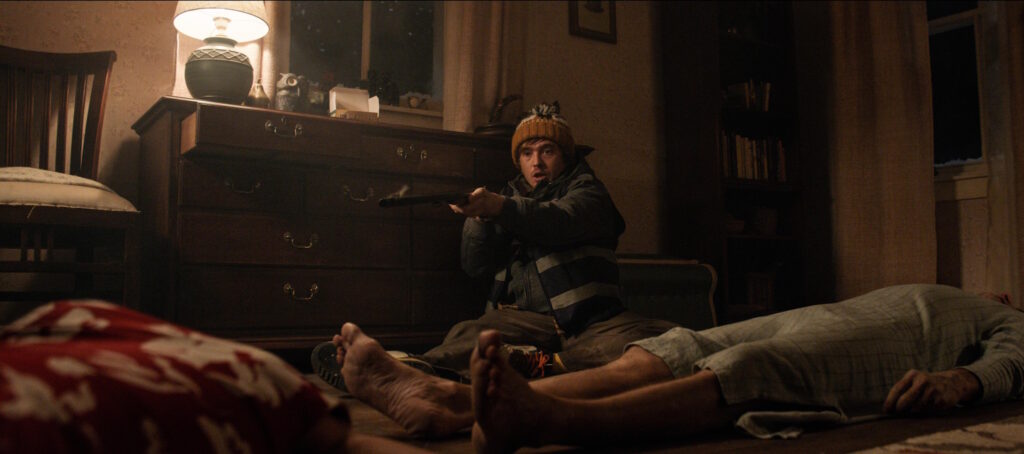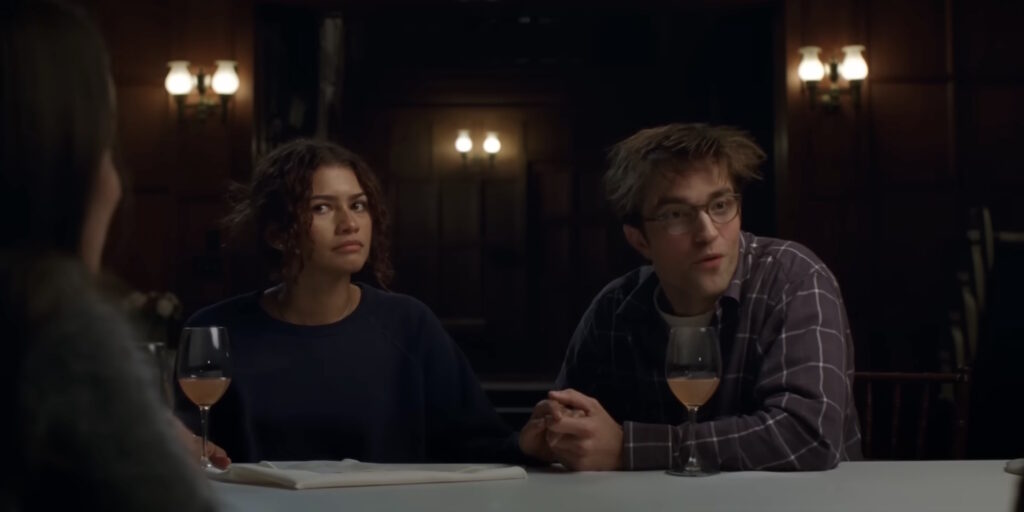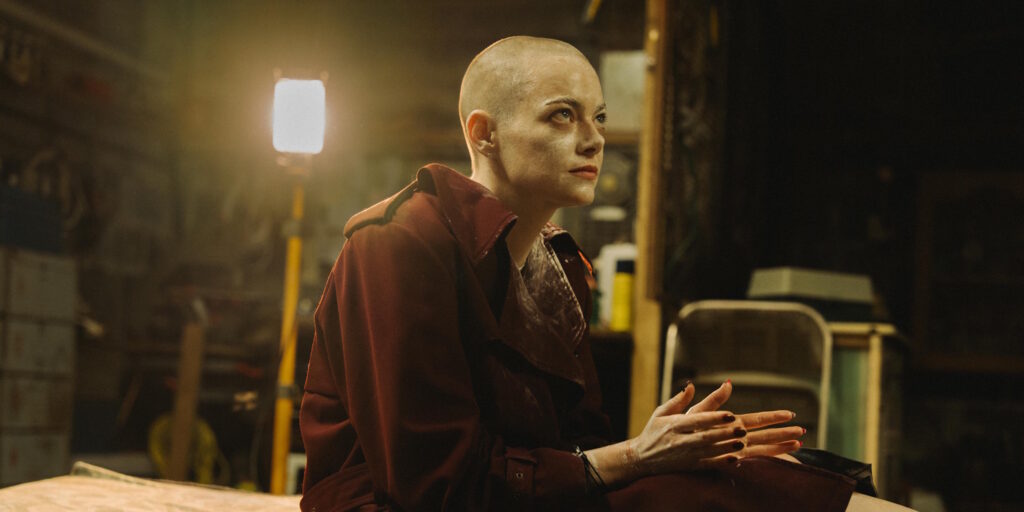

Hlynur Pálmason, whose Godland (2022) chronicled a fraught Herzogian trek across Iceland’s darkly forbidding landscape, turns from the epic to the intimate with The Love That Remains, which explores the ties that tenaciously bind a family after the breakup of its central couple, Anna (Saga Garðarsdóttir) and Magnús (Sverrir Guðnason). If that summary seems to promise a gloom-enshrouded psychodrama – perhaps a riff on Scenes from a Marriage by that most famous of furrowed-brow Nordic filmmakers, Ingmar Bergman – The Love That Remains will wonderfully surprise. Although punctuated with moments of tension and white-hot flares of anger, the film gracefully sidesteps pervasive grimness with antic humor, interludes of transporting natural beauty, and increasingly frequent excursions into surreal fantasies (wait for the giant avenging chicken). Brimming with enchantments, The Love That Remains even includes an irresistibly charming performance by Pálmason’s own dog, Panda.
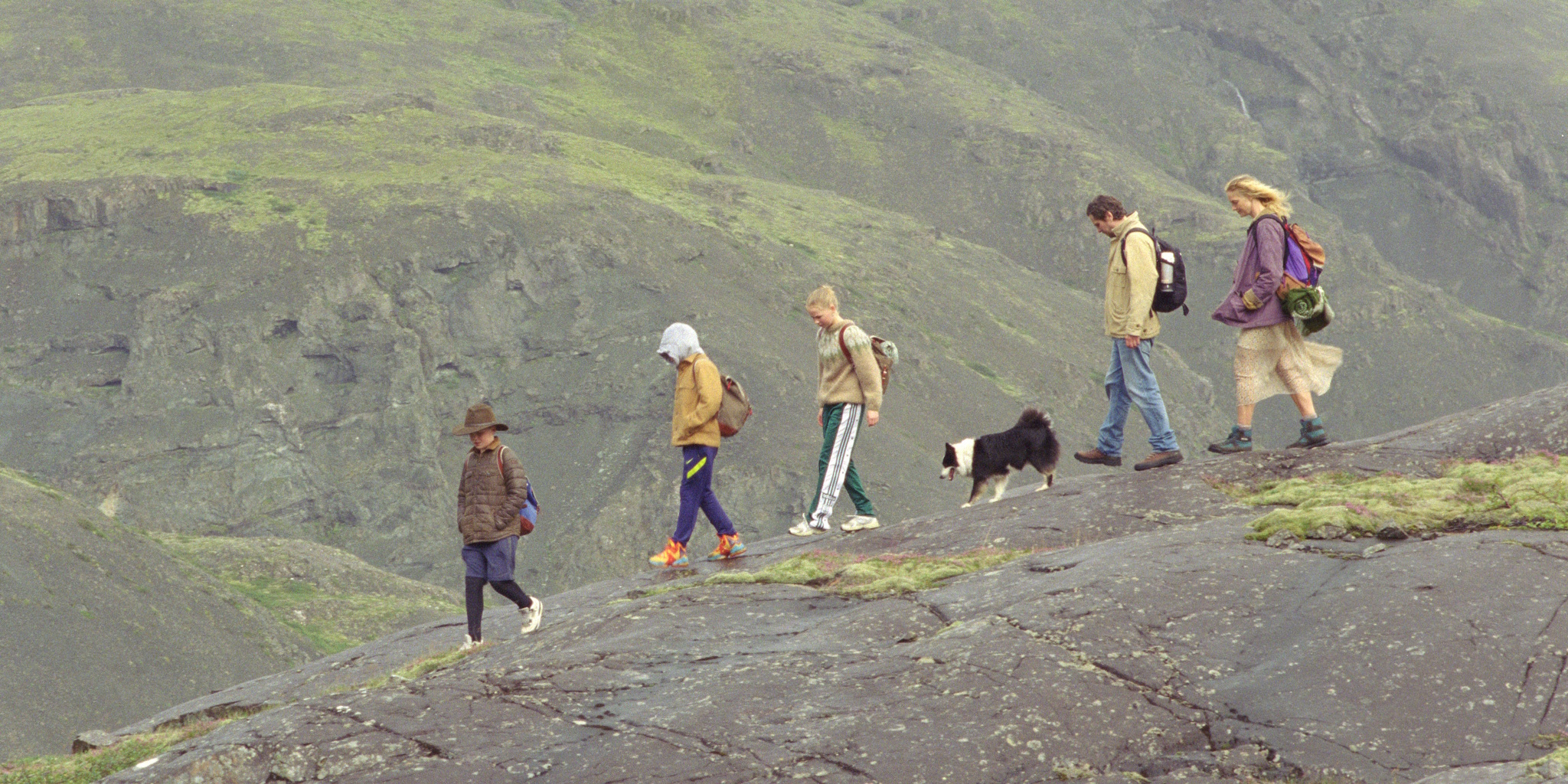
When the film begins, the rupture in Anna and Magnús’ relationship has already occurred, and although Pálmason never offers a precipitating event or pat explanation for the split, it quickly becomes clear that defining personality traits – Anna’s prickliness and fiercely independent spirit, Magnús’ obliviousness and blithe presumption of authority – place them at frequent odds. As the title promises, love still remains, but Anna – who initiated the separation – has firmly moved on, whereas Magnús doggedly resists accepting his new reality, popping up uninvited at the family home and inveigling Anna for sex or an overnight stay. Despite these stresses, post-breakup life never tips into bitterness and recrimination, and the couple spends amiable time together with their trio of rambunctious but adaptable kids, who are adroitly played by Pálmason’s own brood (his daughter, Ída, also had a significant role in Godland). In fact, one of The Love That Remains’ most enchanting sequences is a full-family excursion to pick wild berries and mushrooms. Even during this apparent idyll, however, Magnús’ unrequited longing for Anna becomes strikingly evident in a delirious shot in which he gazes in dumbstruck wonder up her billowing skirt, dazzled both by the dance of refracted sunlight and her frustratingly alluring undergarments.
Godland featured a traditional if slender plotline – a priest’s efforts to establish a church in a remote Icelandic settlement – but in The Love That Remains, Pálmason ties the film together with only the most gossamer-thin of narrative threads, offering a series of vignettes that provide telling glimpses of the family’s quotidian lives and their even more dramatically revealing dreams and imaginings. Pálmason primarily unifies the film with periodic scenes that record the family members’ daily activities. Anna is a visual artist, and The Love That Remains painstakingly records the laborious, time-consuming, and nature-dependent process by which she creates her rust-based canvases (the director has a parallel career as a visual artist, and he uses the same techniques). As Anna labors on her art – sometimes aided by her family – Magnús works on a fishing boat, and the ship’s operations receive a similar level of detailed attention throughout the film.
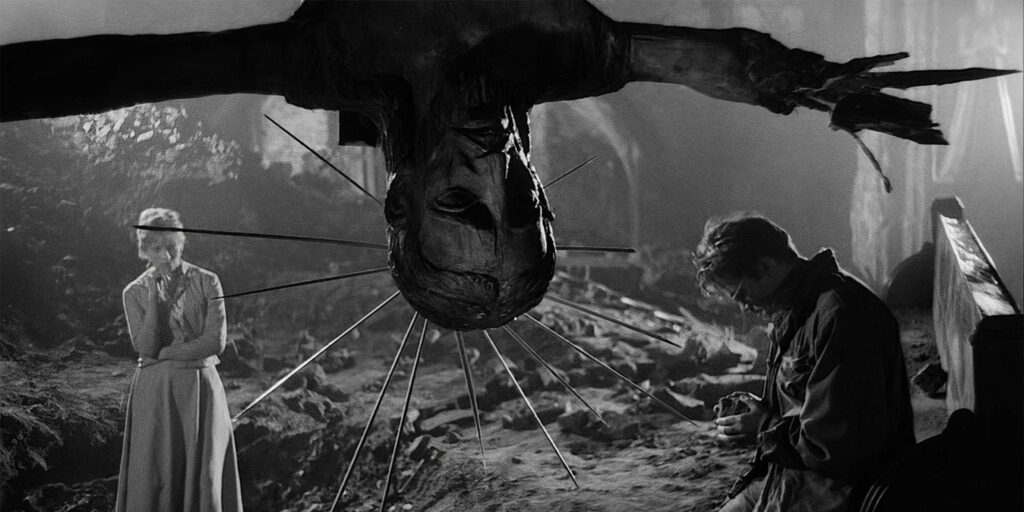
The third recurrent element is perhaps the most intriguing and pregnant with meaning: Over the film’s course, the three children – teen Ída and her younger twin brothers, Þorgils and Pálmi – dig a deep hole, insert a large pole into the excavated ground, build a mannequin that resembles a knight, tie the figure to the buried stake, and then relentlessly pepper it with arrows. (Pálmason actually made a separate film, Joan of Arc, about this project; it’s currently available on the Criterion Channel.) Although the kids appear to adjust well to their parents’ altered circumstances, the ambiguously gendered knight can be read as representing both Anna and Magnús, and the constant arrow assault – bristling with shafts, the figure often resembles a porcupine – provides the trio with a relatively benign way to express their frustrations. Pálmason employs this setup in multiple provocative ways: Amusingly but significantly, the first projectile the children release pierces the dummy’s groin; a subsequent errant arrow causes a significant turn in the story; and the knight later haunts Magnús in an erotically charged dream.
The knight is only one of many evocative means that Pálmason uses to represent the disordered state of Anna and Magnús’ relationship. The film begins, for example, with the destruction of a building, its roof pried loose and dangling precariously from a crane. (We eventually gather from context that the structure was Anna’s former studio, though that’s never explicitly stated, in keeping with the film’s elliptical approach.) When Magnús’ fishing vessel reels in a mine left from World War II, the unexploded ordnance hints at a future detonation in his own repressed anger. In a sequence of paired shots, the twins stand side-by-side to hold a massive fish but then move apart to reveal that the creature is actually cut in half, with one of the boys now grasping the head and the other the tail. And in the most extended of Pálmason’s inventive metaphors, after an accident at home, Magnús is dropped by his shipmates into the ocean, but the boat that’s supposed to retrieve him never arrives, and he floats aimlessly in the water: Unmoored from his former life, he’s both figuratively and literally lost at sea.
As Godland abundantly demonstrated, Pálmason excels at the composition of striking images, and The Love That Remains, although looser and less fussily constructed, provides more evidence of his picture-making mastery, with the director this time also serving as cinematographer. The Love That Remains occasionally recalls the work of filmmakers as disparate as Terrence Malick and David Lynch, but Pálmason emerges as utterly singular, a unique talent who manages to balance thematic seriousness with a winningly sly sense of humor.
The Love That Remains screens nightly at 7:00 p.m. on Mar. 20 – 22 at the Webster University Film Series.