
Roughly 28 weeks after one of the most bizarre cliffhangers in summer-blockbuster history, a follow-up has finally arrived, albeit through a different lens. Vacating the director’s chair, Danny Boyle hands the franchise’s reins to Nia DaCosta (Candyman, Hedda), who makes the sequel to 28 Years Later her own. The last time this happened, Juan Carlos Fresnadillo’s 28 Weeks Later (2007) still retained positive reviews and a successful box-office turnout, but it’s apparent how much Boyle and writer Alex Garland wanted their legacy sequel trilogy to be a course correction. Given that Weeks emerged as the black sheep of the series with its action-horror approach and lack of a humane touch, it’s understandable why the duo would rather keep things consistent with the original, telling an emotional story about living in a time that seems defined by rage and isolation. DaCosta, working from Garland’s script, manages to find a sweet spot between respecting their wishes and doing her own thing with 28 Years Later: The Bone Temple.
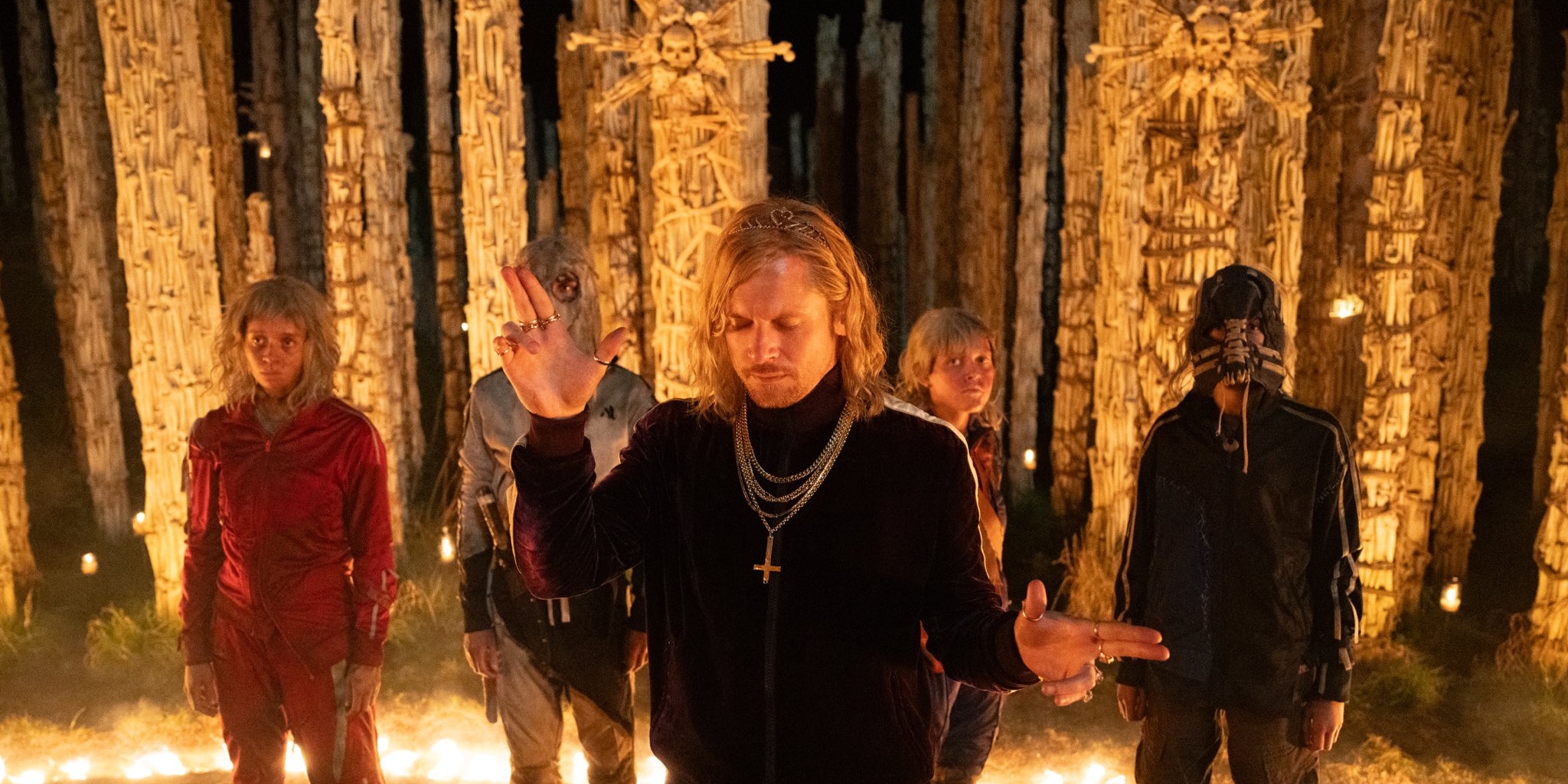
Picking up moments after Spike (Alfie Williams) meets the Teletubby-color-coordinated tracksuit-wearing cult of the Jimmys, DaCosta and Garland continue exploring the post-virus world of wonder and horror. As Spike is initiated into this vicious satanist cult, the focus shifts to its leader, Sir Lord Jimmy Crystal (Jack O’Connell in yet another fun horror-villain role this side of the Rocky Road to Dublin). It turns out that Sir Jimmy is the kid from 28 Years Later’s traumatic opening, who it seems has done everything but grow up. Now a dead-toothed, Jimmy Saville-cosplaying psycho, his desire for the control that was destroyed during his childhood has led to a state of arrested development. Desensitized to the chaotic violence of the Rage virus, he happily brings that same level of barbarism to his fellow survivors. Jimmy’s fight for control has reaped him a cabal of young followers to share his plight, though his detachment only allows him to see them as tools, his “seven fingers.” That number is apparently sacrosanct, as new recruits are forced to fight an existing finger to the death. Any hope that Spike has gained from remembering to love is quickly washed away when he watches a member bleed out from an accidental stab wound. Sir Jimmy is a walking reminder of why Spike’s former island village minimized contact with the mainland.
This brutal reality that Spike finds himself in is shared by DaCosta’s direction, which takes the pulpy, handheld filmmaking of the previous films and gives it a colder treatment. Now shot with a standard professional digital camera, Sean Bobbit’s lensing and Jake Roberts’ editing are more calm and composed compared to the frenzied kineticism in the prior films (even 28 Weeks Later shared the same sense of mayhem). Yet, despite this stylistic approach not necessarily fitting in with the series’ filmic mantra, DaCosta succeeds in making this relative restraint work. Instead of giving in to the potential pandemonium of the Jimmys committing home invasions, the more removed portrayal of them flaying their victims and baiting one finger to engage in an ill-fated death match creates its own disturbing effect on par with the series’ usual displays of excessive depravity.
Keeping the series grounded, DaCosta is able to further dive into the themes left in 28 Years Later’s wake. Parallel to Jimmy’s menacing power, Dr. Ian Kelson (Ralph Fiennes) is further explored beyond the innocent lens previously seen by Spike. The Bone Temple shows more of his life of solitude, in which he spends his days listening to vintage vinyl records from pre-pandemic times. Restless in his isolation, Kelson grows more interested in a local alpha he names Samson (Chi Lewis-Parry), who becomes addicted to the morphine after the doctor drugs him with a blowgun dart in self-defense. Somehow, despite the alpha’s skull-ripping nature, the two figures create a potential bond. The good doctor even entertains a faint hope that the decades-long effects of the Rage virus could be reversed.
With a now-established thematic dynamic between the film’s depiction of good and evil in this English apocalypse, the two forces don’t converge until Bone Temple’s second half, building toward the film’s hope for redemption in various ways; a chance for Sir Jimmy to heal himself from the torment of his private satanic mythology, for Spike to be able to leave the cult behind after realizing their misanthropic nihilism, and for Kelson to miraculously create a connection between the Infected and non-infected. Yet, in between this grounded angst, DaCosta and Garland allow themselves to let loose.
Although the series’ more dream-like qualities are absent, Bone Temple follows an out-there disruptiveness on par with a man wandering through an abandoned London or a chase scene set under the Aurora Borealis. Showing off a sense of humor, sequences such as a drugged-out Samson and Kelson dancing along to Duran Duran or Jimmy describing the Teletubbies as though his half-remembered show were Holy Scripture maintain the series’ tradition of standing apart from the miserablist tropes of the zombie film. It shares enough of the audacious franchise’s DNA – evident in time-lapse shots of the titular ossuary under the night sky scored to Radiohead, or in an abrupt and raucous Iron Maiden music video starring Ralph Fiennes – to bend the rules of the genre and provide some fun alongside the weighty ideas it proffers.
The bridge between DaCosta’s stand-alone style and Boyle/Garland’s storytelling falters somewhat when the film needs to be emotional. The new film’s focus is divided between Kelson and Jimmy, leaving Spike, the unexpected standout of 28 Years Later, in a secondary role. He still gets to have an arc as he tries to escape the grasp of the Jimmys, but the more omniscient viewpoint sacrifices the palpable perspective of a child witnessing pure evil. Compared to the meatier, incredible performance he gave last summer, Williams doesn’t have as much to do here to show off his versatility. Contrasting the liveliness of 28 Years’ world and story, Bone Temple’s rigidness leads to an interesting narrative surrounding faith, masculinity, and power in the apocalypse that ends up a bit too clean.
There are chinks in Sir Jimmy’s villainous armor: One of his fingers, Jimmy Ink (Erin Kellyman), is quietly having a crisis of faith and later allies with Spike. However, the nuances in her character are sacrificed to position her more simplistically as the kid’s defender and Sir Jimmy’s defier. Kelson’s journey in finding a cure for Samson prompts the viewer to question if a cure is necessary for an Infected person who has grown used to his savage way of life over almost 30 years. Kelson wishing for Samson, the ripped, bestial Infected, to become a “normal” person connects the story to Britain’s history of colonizing those they don’t understand. However, before DaCosta can truly explore the non-consensual nature of Kelson’s intentions for Samson, the film’s speedier pacing doesn’t allow much time to explore the nuances of this plotline.
Despite missing a few of the components that made 28 Years Later such a cathartic and thought-provoking take on the ever-present apocalyptic dread of the 2020s, The Bone Temple effectively continues its predecessor’s themes. Acknowledging the world’s current crisis of masculinity and its growing contingent of power-hungry man-children, Garland crafts a satisfactory narrative by leaning into the optimism of the last film. Evil may be growing more powerful in today’s landscape, where seemingly anything can be done without consequence as long as you have enough power. However, as Bone Temple’s story asserts, if given enough time, such evil will eat itself alive. It may not be as powerful as a child having to learn that love and death can be strange bedfellows, but it’s something to ponder in a time that seems to be teetering on the verge of doomsday.
Wherever Boyle and Garland take this series in the final entry of the trilogy – Bone Temple concluding with yet another cliffhanger, albeit this time with a dash of fan service – one prays that it will continue to redefine the zombie film and provide some desperately needed hope for our present, perilous times.
28 Years Later: The Bone Temple is now playing in theaters everywhere.